
The commonest reason people ask about revision after a breast lift or reduction is that the two sides do not match.
The commonest reason they did not match beforehand is that almost nobody is symmetrical to begin with, and surgery makes people look at themselves with an attention they have never applied before.

Wait until the shape has arrived
Breasts sit high and tight after this operation and then settle downward over months as swelling resolves and tissue relaxes.
That means the shape at six weeks is not a result, and judging it then produces complaints about things that will resolve on their own.
Surgeons generally ask for at least six months before considering revision, and often longer where scars are involved, since scars pale and flatten over a year or more.
The German Society of Plastic, Reconstructive and Aesthetic Surgeons publishes patient information about plastic surgery procedures and standards, which is a reasonable independent reference on how the field approaches secondary procedures.

What actually gets revised
| Concern | Often settles on its own | What revision would involve |
|---|---|---|
| One side larger than the other | Partly, as swelling resolves unevenly | Adjusting the larger side, usually minor |
| Puckering at the end of a scar | Sometimes, over several months | A small excision, lengthening the scar slightly |
| Breast dropping below the scar over time | No, this is a late change | Removing skin from beneath to re-tighten |
| Scars wider or raised than expected | They improve for a year or more | Scar revision, once fully mature |
| Nipples sitting at different heights | Partly, as the breast settles | Adjustment, judged standing |
| Still too large for comfort | No | Further reduction, with the same trade-offs |
The middle column is why the wait exists. Several rows resolve without an operation, and operating early converts a temporary finding into a permanent scar.

What does not wait
The six-month rule applies to shape. It has never applied to healing, and conflating the two is the mistake worth avoiding.
A wound that opens, spreading redness, discharge, fever, or pain that increases rather than eases all need to be seen promptly wherever you are.
So does a nipple or an area of skin that changes colour, and one breast that becomes suddenly larger or harder than the other.
None of that is revision. It is ordinary post-operative care and it belongs with a clinician who can examine you today, as breast lift and reduction recovery stage by stage sets out.

Symmetry is a reasonable goal and a poor promise
This is the honest part of the conversation, and it is better heard before the first operation than after it.
Two breasts on the same person differ in volume, in the position of the fold beneath, and in where the nipple sits. They also heal independently.
Surgery improves symmetry. It does not manufacture it, and a revision aimed at making two sides identical is aiming at something that did not exist beforehand.
This is where your own pre-operative photographs earn their keep, because they show what you actually started with.
Scars have their own timetable
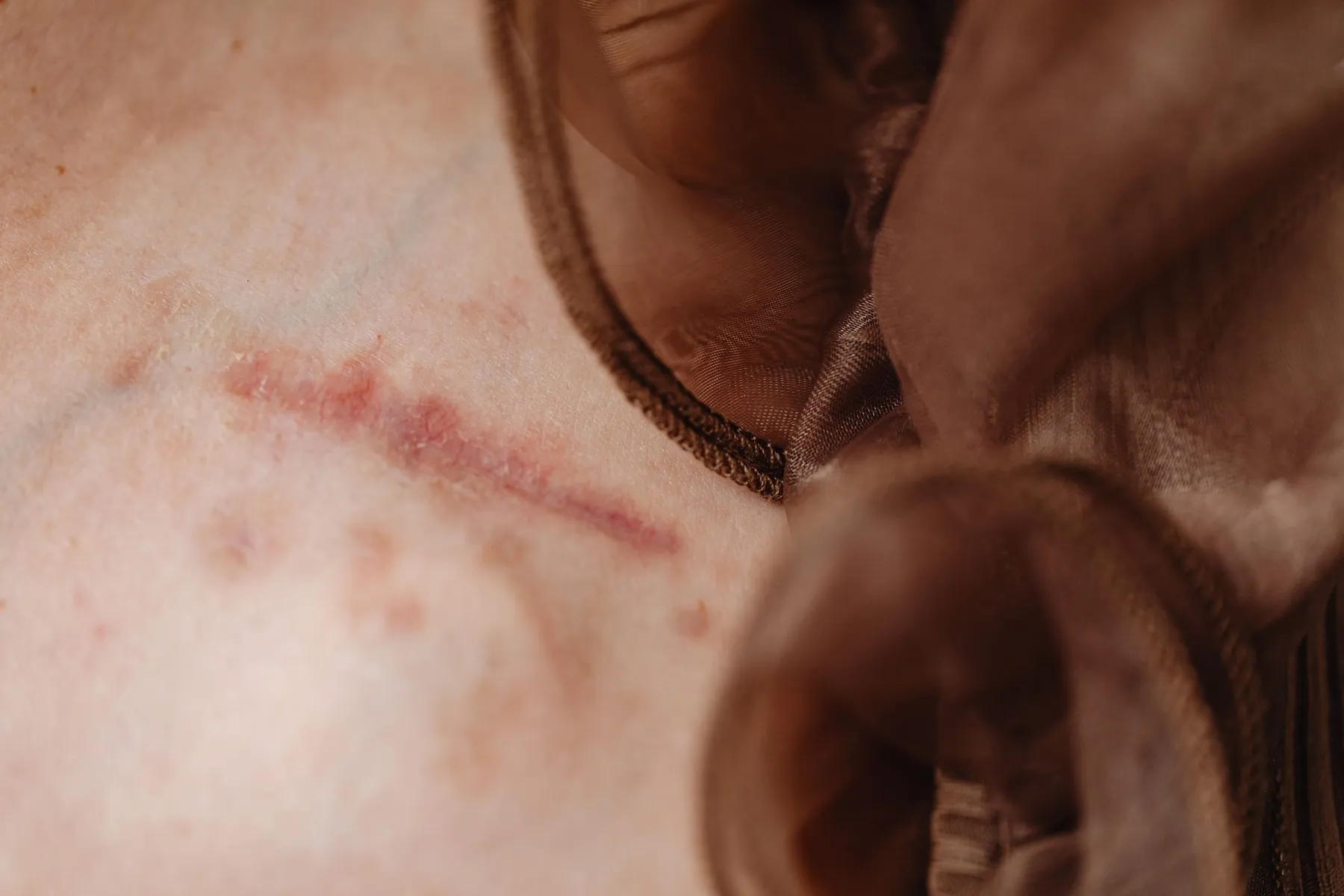
More revision enquiries concern scars than shape, and most of them arrive at the worst possible moment to judge them.
Scars look worse at six to eight weeks than at two, turning red and raised before they begin to soften, which reads as a bad result to anyone not warned about it.
Over a year or more they usually pale and flatten. Revising one before it has matured means cutting out an active scar and starting the same process again.
Ask what non-surgical scar care is advised first, since a good deal of what people want revised responds to time and treatment rather than to a second operation.
What a second operation costs you beyond money
Revision here is not a touch-up, and it is worth weighing what it actually involves.
- More scar, not less, since correcting a pucker usually lengthens a line.
- Another anaesthetic, with the risks that carries.
- Another recovery, including the lifting restrictions.
- Blood supply already disturbed once, which narrows what is safe.
- Sensation that may change again, having partly recovered.
- No certainty of being the last one.
The fourth point is the one most often left unsaid. A surgeon operating on a breast that has already been reshaped is working with less margin than the first time.
Weight and pregnancy undo results too
Not everything that changes after this operation is a consequence of the operation, and separating the two saves an unnecessary consultation.
Breast tissue responds to weight and to pregnancy whether or not it has been reshaped, so volume gained or lost afterwards will change what you were given.
A breast that has dropped two years after a lift, following a pregnancy or a significant weight change, is behaving normally rather than failing.
That does not mean nothing can be done. It means the conversation is about a further operation on a changed body rather than about correcting the first one.
Taking the first operation with you
Any surgeon assessing a revision wants to know what was done, and deducing it from the outside is guesswork.
Bring the operation note if you have it, including which incision pattern was used, how the nipple was moved, and how much tissue was removed from each side.
Bring the pathology result too, if tissue was examined, since it is part of your medical record rather than a formality.
And bring photographs of yourself before the first operation, which is the only way to establish what was there to begin with.
Deciding whether to have one
- Wait until the shape has stopped changing, which is months rather than weeks.
- Name the complaint precisely, in one sentence.
- Compare against your own pre-operative photographs, not against anyone else.
- Ask what would change and what would not, in your case.
- Weigh it against a second recovery honestly.
A specific, nameable complaint tends to revise well. A general sense that something is not right usually does not, because there is nothing precise to aim at.
Questions people ask
Is a small asymmetry worth operating on?
That depends entirely on how much it affects you, and it is a fair thing to weigh openly. A difference nobody else notices may still be worth correcting, or it may not be worth another scar.
Can scars be removed completely?
No. A scar can sometimes be made narrower or flatter, which means exchanging one scar for another in the hope of a better one. Wait until it has matured before deciding.
Should I go back to the original surgeon?
They know what was done, which is a real advantage. Seeking a second opinion is also reasonable and is not a criticism of anyone.
How do I arrange an assessment?
Through the clinic contact details, which cover both locations. What the original operation involves is described in what happens during a breast lift or reduction.
Medical information notice. This page is general information. It is not medical advice and does not replace consultation with a qualified medical professional. All surgery carries risk; suitability, recovery and results vary from person to person and are determined by individual medical assessment.